3.2 Controlled Airspace (Classes A through E)
Lesson Progress
Not completed
This lesson covers the specific entry requirements and restrictions for the five classes of controlled airspace.
Interactive Airspace Viewer
Section titled “Interactive Airspace Viewer”(Insert your interactive airspace component here as an additional resource. Students can use it to visually review the limits and requirements of Classes A-E alongside the text below).
Aerodromes and Air Navigation (AARN) Airspace Model
Use the class buttons below to view VFR minima and HG/PG-focused operating requirements.
Class E
VFR minima
- Flight visibility: 3 SM.
- Cloud clearance: 500 ft vertical and 1 SM horizontal.
HG / PG pilot requirements
- No ATC clearance required for VFR transit.
- Remain outside control zones unless entry requirements are met.
1. High Level & Transition Airspace
Section titled “1. High Level & Transition Airspace”Class A
Section titled “Class A”Class A airspace is restricted to IFR traffic, so hang gliders are not allowed.
It exists:
- Everywhere over 18,000 ft ASL in the SDA.
- Over FL 230 / FL 280 in the NDA.
It does not specifically appear on VNC charts.
Class B
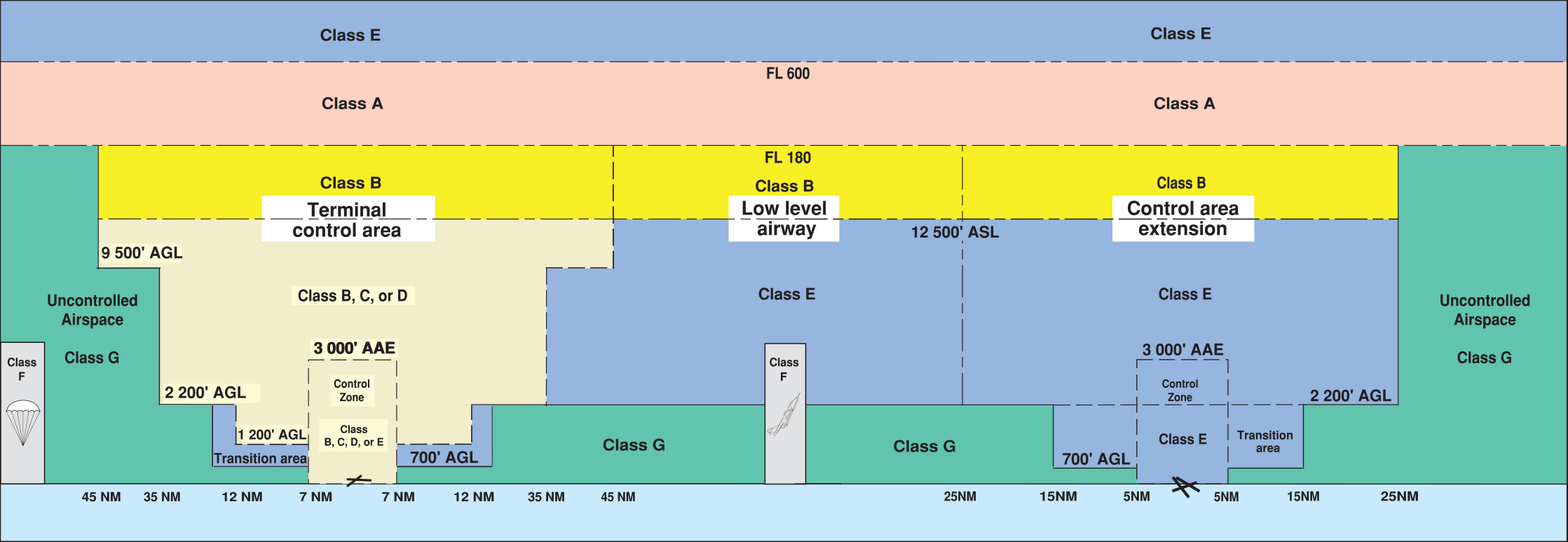
Section titled “Class B”Class B airspace exists above other controlled airspace between 12,500 ft ASL and 18,000 ft ASL everywhere in Canada.
Actually, Class B Airspace exists above controlled airspace above 12,500 ASL or above the Minimum Enroute Altitude (MEA) whichever is the highest.
Both IFR and VFR aircraft are allowed in Class B. There is nothing in the CARs that specifically exclude HG in Class B airspace. However, like other VFR traffic, a HG must obtain a clearance from ATC to enter Class B airspace as well as meet other conditions that are somewhat impractical, albeit not impossible, for a hang glider.
2. Terminal & Control Zone Airspace (Class C & D)
Section titled “2. Terminal & Control Zone Airspace (Class C & D)”Class C and D airspaces exist in Control Zones (CZs) and Terminal Control Areas (TCAs) around airports (Class C around major airports, Class D around some airports). Both IFR and VFR aircraft are allowed, and there is nothing in the CARs that specifically excludes hang gliders from either.
Common Requirements for Class C & D
Section titled “Common Requirements for Class C & D”- Radio requirement: You must establish two-way radio contact with the appropriate ATC unit (the tower for a CZ, or the terminal for a TCA) before entering.
- Separation: ATC provides conflict resolution between IFR and VFR traffic, but not between VFR and other VFR traffic.
Differences
Section titled “Differences”While the requirements look identical, the difference in how you enter these two airspaces is highly testable on the exam.
- Class C: You must obtain an ATC clearance before entering.
- Class D: You must establish two-way communications prior to entering.
3. Class E Airspace & The Hang Glider Rule
Section titled “3. Class E Airspace & The Hang Glider Rule”Class E is designated where an operational need exists for controlled airspace but does not meet the requirements for Class A, B, C or D.
It is found in low-level airways, control area extensions, transition areas, or CZs without an operating control tower.
ATC separation is provided only to IFR aircraft; there are no special requirements for VFR aircraft.
However, you may operate a hang glider in Class E airspace ONLY IF:
- The pilot is at least 16 years of age.
- The pilot is in possession of a Category 1, 3 or 4 medical certificate.
- The pilot has obtained a grade of not less than 60% on the HAGAR examination.
- The hang glider is equipped with a magnetic compass and altimeter.
- The flight is a cross-country flight.
- You inform the nearest Flight Service Station (FSS) of the time of departure and estimated duration of the flight in Class E airspace.