3.1 Canadian Domestic Airspace & Uncontrolled Airspace
Lesson Progress
Not completed
This lesson covers the broad geographic divisions of Canadian airspace, the difference between controlled and uncontrolled airspace, and the rules of Class G airspace.
1. Canadian Domestic Airspace
Section titled “1. Canadian Domestic Airspace”Canadian domestic airspace is geographically divided into the Southern Domestic Airspace (SDA) and the Northern Domestic Airspace (NDA).
The reason for the division is because magnetic compass indication can be erratic in the NDA.
As a result:
- SDA: Magnetic indications are used.
- NDA: Magnetic indications are not used (true headings are used instead).
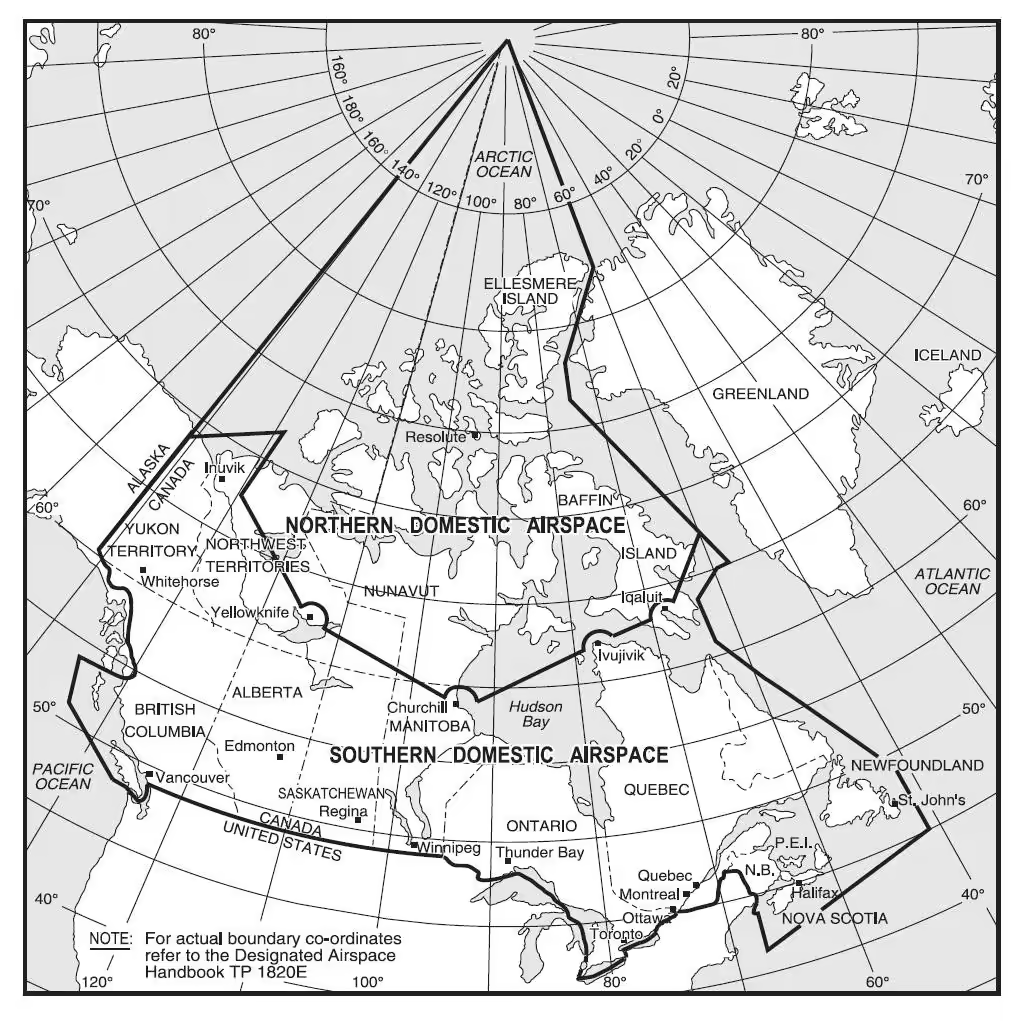
The Canadian domestic airspace is further divided vertically:
- Low Level Airspace: Consists of all airspace below 18,000 feet ASL.
- High Level Airspace: Consists of all airspace from 18,000 ASL and above.
In the SDA:
- All high-level airspace is controlled Class A airspace.
In the NDA:
- All high-level airspace above Flight Level 230 (FL 230) is Class A.
- The airspace between 18,000 ft ASL and FL 230 is Class G airspace.
2. Controlled and Uncontrolled Airspaces
Section titled “2. Controlled and Uncontrolled Airspaces”Canadian domestic airspace is either controlled or uncontrolled.
- Uncontrolled airspace is Class G airspace.
- Controlled airspace can be Class A, B, C, D, or E.
Controlled airspace is the airspace within which air traffic control (ATC) service is provided and within which some or all aircraft may be subject to ATC.
VMC vs. IMC
Section titled “VMC vs. IMC”- VMC (Visual Meteorological Conditions): Pilots flying in VMC can use VFR (or IFR if qualified).
- IMC (Instrument Meteorological Conditions): All pilots flying in IMC must use IFR.
All aircraft flying under Instrument Flight Rules (IFR) are always under control of ATC in controlled airspaces. However, aircraft flying under Visual Flight Rules (VFR) are not controlled by ATC in all classes of controlled airspace.
3. Uncontrolled Airspace – Class G
Section titled “3. Uncontrolled Airspace – Class G”Uncontrolled airspace is all airspace that is not controlled and where a HG/PG pilot can fly without having written the HAGAR examination.
Chart Depiction
Section titled “Chart Depiction”Class G airspace is not specifically shown on VFR charts. Instead, if some airspace is not specifically identified as controlled airspace on a VFR chart, then it is Class G airspace.
Where it exists
Section titled “Where it exists”A lot of Class G airspace in Southern Canada exists below controlled airspace (e.g., from the ground up to a specific altitude where Class E, C, or D begins).
Class G airspace exists:
- Up to 18,000 ft ASL if it is not capped by controlled airspace.
- Up to FL 230 in the NDA.
Just because there are no restrictions to flying hang gliders in Class G airspace does not mean there are no rules. All the CARs that are not airspace-specific are still applicable in Class G.