2.2 Symbology and the "Inverted Cake" Airspace
Lesson Progress
Not completed
VNC Chart Symbology
Section titled “VNC Chart Symbology”VNC charts may look daunting, but most of the clutter consists of geographical features used so a pilot flying from Point A to Point B can track progress visually. Aviation-specific information on VNC charts consists of airspaces, aerodromes, radio navigation aids, and air routes. We discuss airspaces and navigation in more detail in later course sections.
The legend: The most important part of a VNC chart is the legend. Everything on the chart is described there. There is no need to memorize everything — look at the legend whenever you are unsure. You do not have to know everything on the legend to write the exam so we don’t go into everything in this course. You can find information about the terms that are not covered in the AIM.
Airspace Depictions Overview
Section titled “Airspace Depictions Overview”VNC charts depict the various types of airspaces up to 18,000’. This includes Class C, D, E, and F airspace. Class G airspace (uncontrolled) is all airspace that is not Class C, D, E, or F, so it is not identified specifically on the chart.
Airspace floors: All airspaces have a floor (the lower altitude at which the airspace begins).
- The floor of Class B airspace is almost always 12,500’ ASL.
- Class E exists below Class C and D, and Class G exists below Class E.
- The floor of Class F airspace is always ground level.
- The floor of a Control Zone (CZ) is always ground level.
The “Inverted Cake” Model of Canadian Airspace
Section titled “The “Inverted Cake” Model of Canadian Airspace”Airspace around certified aerodromes (airports) looks like a wedding cake flipped over on its top. The image below shows a simplified version. For a more detailed model, you can refer to Transport Canada’s Canada’s Airspace poster.
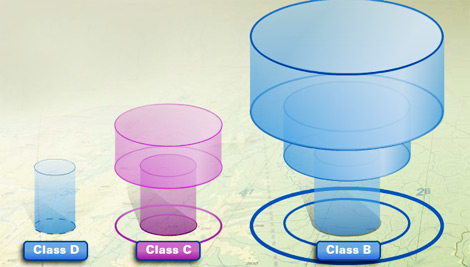
Layers of the cake
Section titled “Layers of the cake”- Control Zone (CZ): The bottom layer centered around the airport. CZs always start at ground level and extend to a specified altitude ASL. Not all airports have control zones, and some only exist during specified hours (found in the CFS, not the VNC).
- Terminal Control Area (TCA) and Control Area Extension (CAE): The second layer surrounding CZs, but not all CZs have a TCA or CAE around them.
- TCAs are Class C or D airspace.
- CAEs contain Class E airspace.
- They can have multiple layers with floor/ceiling values increasing outward. Floors are typically at 700’, 1,500’, 2,500’, and 4,000’ ASL but could exist at other altitudes in special cases.